Human Heart with Flowers Tumbler Wrap 20
A Designer’s First Glance: Soft, Sentimental, and Surprisingly Versatile
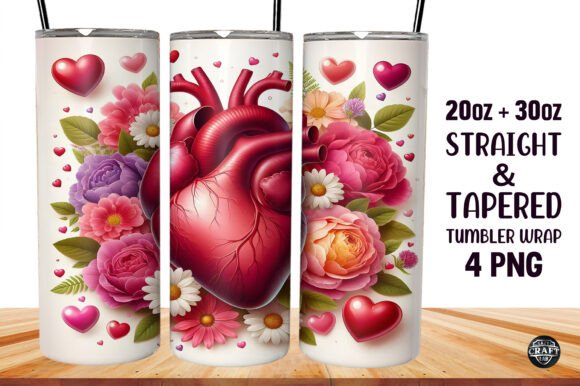
When I opened Human Heart with Flowers Tumbler Wrap 20, I didn’t see just another tumbler graphic—I saw a quiet emotional anchor. The heart isn’t cartoonish or clinical; it’s anatomically suggestive but softened by delicate floral tendrils curling along the edges—roses, maybe lavender sprigs, and subtle leaf veins that hint at growth and care. It’s not overly busy, yet it holds enough detail to feel intentional. As an embroidery designer who regularly translates digital graphics into stitched texture, my first question was always: Will this hold up when translated into thread? The answer, after testing on a linen tea towel and a cotton baby onesie, is yes—but with thoughtful adaptation.
Where This Design Truly Shines in Real Embroidery Projects
I used Human Heart with Flowers Tumbler Wrap 20 as the centerpiece for a custom embroidered tote bag destined for a nurse’s birthday gift. On natural canvas, the heart’s organic shape read clearly, and the flowers added gentle visual rhythm without overwhelming the fabric’s texture. It also worked beautifully as a sweatshirt embroidery piece—scaled down to 3.8 inches wide—when paired with a lightweight tear-away stabilizer. The curves held their integrity, and the negative space between petals allowed breathability in the stitch layout.
For Etsy sellers and small shop owners, this design bridges sentimental appeal and commercial practicality. It’s strong enough for boutique nursery decor (think pillow covers or muslin swaddles), refined enough for wedding guest favors (embroidered on linen napkins), and warm enough for holiday gifts like personalized kitchen towels. As a machine embroidery design, it avoids dense fill-stitch traps—no tiny interior sections that would pucker thin knits or distort stretchy fabrics. That makes it safer for baby embroidery and custom apparel where comfort matters as much as aesthetics.
Where to Proceed With Care
Don’t assume Human Heart with Flowers Tumbler Wrap 20 is plug-and-play on every surface. On curved cap fronts, the upper floral elements compressed slightly during hooping—so I recomposed the layout to center the heart body and let the topmost blossom fall just outside the typical cap embroidery zone. On dark fabric, especially charcoal or navy, I tested thread colors first: a soft rose pink satin stitch for the heart and muted sage green for stems kept contrast legible without screaming.
It’s not ideal for ultra-small hoop sizes (under 3 inches) without simplification—the finer petal outlines can blur or skip stitches if pushed too far. Likewise, avoid layering it directly over seams or thick seams on aprons or structured tote bags unless you reinforce with cut-away stabilizer. And while it’s labeled a tumbler wrap, remember: this is a graphics file—not a pre-digitized embroidery file. If you’re sourcing it for machine embroidery, confirm whether it’s been digitized already or if you’ll need to convert it yourself. Licensing is equally critical: verify whether the PNG grants commercial rights for finished embroidered products before listing on Etsy or bundling into craft kits.
What It Adds—and What It Doesn’t Promise
This design elevates handmade presentation not through flash, but through resonance. Customers recognize sincerity in embroidery that feels considered—not generic. A client once told me her customers “just *knew* it was made with care” when they saw the heart’s gentle asymmetry and the way the flowers followed its contour. That kind of intuitive trust is gold for creative entrepreneurs.
But let’s be real: Human Heart with Flowers Tumbler Wrap 20 won’t carry your brand alone. It’s a strong supporting player—not a logo replacement. Use it to complement consistent typography, cohesive color palettes, and intentional product curation. It doesn’t solve poor stabilizer choices or mismatched thread weights. Its value multiplies when paired with smart execution: proper tension, appropriate needle size for your fabric, and mindful placement (e.g., left chest vs. center back).
Practical Notes Every Embroidery Designer Should Run Through
- Test on scrap fabric first—especially if using textured weaves like burlap or slub cotton.
- Check thread color contrast across light, medium, and dark backgrounds using printable mockups.
- Review stitch density if digitizing from the PNG—avoid overloading fine floral tips with heavy satin stitch.
- Confirm hoop size compatibility before committing to production runs.
- Inspect small details under magnification: are petal edges clean? Do stem lines taper naturally?
- Try black-and-white mockups to assess value separation—essential for gift items where color accuracy may vary.
- Use proper stabilizer: lightweight cut-away for knits, tear-away for stable wovens, and fusible for lightweight linens.
- Verify licensing before selling finished products or reselling as part of a digital embroidery bundle.
Final Thought: A Quiet Anchor in a Busy Market
In a sea of bold fonts and trending motifs, Human Heart with Flowers Tumbler Wrap 20 stands out by leaning into tenderness—not trend. It’s not flashy, but it’s memorable. As a design asset, it serves craft businesses well when treated with intention: scaled thoughtfully, stabilized correctly, and placed where emotion meets utility. Whether you’re stitching a one-of-a-kind baby gift, building a line of wellness-themed apparel, or curating heartfelt merchandise for a local boutique, this design earns its place—not because it shouts, but because it listens.