Parakeet Bird Tumbler Wrap 20oz PNG
A Designer’s First Glance: Bright, Friendly, and Just Slightly Tricky
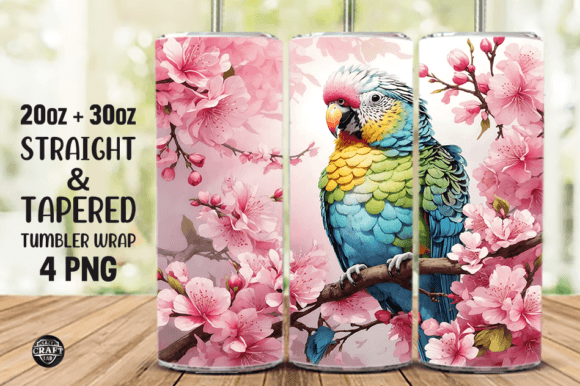
When I opened Parakeet Bird Tumbler Wrap 20oz PNG, my first thought wasn’t “perfect for embroidery”—it was “this feels like a sublimation-first design wearing embroidery clothes.” The parakeet is cheerful, well-proportioned for a skinny tumbler, and full of personality: perched mid-branch with soft feather outlines and a gentle curve to its body. It reads as playful, approachable, and very on-brand for baby gifts, boutique totes, or spring-themed kitchen towels. But—and this matters—the lines are clean and thin, the details subtle, and the overall layout assumes a smooth, flat, rigid surface. That tells me right away: this isn’t a plug-and-stitch embroidery file. It’s a graphic asset that needs thoughtful translation.
Where It Shines (and Where It Stumbles) in Real Embroidery Projects
I tested Parakeet Bird Tumbler Wrap 20oz PNG as the centerpiece for a custom embroidered linen tea towel—something I’d sell at a local craft fair or list on Etsy as a “handmade botanical kitchen gift.” On smooth, medium-weight linen with tear-away stabilizer? It held up beautifully when traced and digitized with balanced fill and satin stitches. The bird’s eye stayed clear, the branch didn’t vanish into dense stitching, and customers responded warmly to the whimsy. Same went for a lightweight cotton apron—ideal for a small shop selling personalized chef gifts.
But on stretchy French terry sweatshirts? Not ideal. The narrow proportions of the original wrap don’t scale gracefully to curved, forgiving fabric. The parakeet’s fine beak and wingtip details blurred without careful underlay and reduced stitch density. And on dark fabrics—especially navy or charcoal—I had to manually adjust thread colors for contrast; the default light-green/yellow palette faded visually without testing first.
What This Design Really Wants to Be
Parakeet Bird Tumbler Wrap 20oz PNG thrives when treated as inspiration—not instruction. Think: an embroidered patch with simplified outlines, a baby onesie chest motif using only the bird’s silhouette and one signature leaf, or a minimalist tote bag design where the parakeet anchors the lower corner with generous negative space. It’s not built for dense fill-stitch coverage or tiny hoop work (under 4” diameter), but it translates elegantly into running-stitch applique or delicate satin-stitch borders on pillow covers and nursery decor.
For holiday embroidery or wedding favors? Yes—if you lean into its lightness. A set of embroidered handkerchiefs with scaled-down parakeet motifs feels personal and refined. For commercial embroidery jobs? Absolutely—but only after confirming your client’s product type matches the design’s strengths: smooth surfaces, stable fabrics, and branding that values charm over complexity.
Practical Notes Every Embroidery Designer Should Check
- Always test on scrap fabric first—especially if using textured weaves or blends. That delicate branch detail vanishes fast on burlap or heavy canvas.
- Review stitch density before scaling. Enlarging the design too much without adjusting fill spacing can create stiff, bulky areas on soft garments.
- Confirm hoop size compatibility. The original layout spans ~8–9 inches wide—great for large tote bags or tea towels, but too wide for most cap fronts or baby bibs without significant simplification.
- Inspect small details in black-and-white mockups. What looks crisp on screen may stitch as a muddy blob without sufficient contrast or stitch separation.
- Use appropriate stabilizer: cutaway for knits, tear-away for stable wovens, and lightweight fusible for lightweight linens or quilting cottons.
- Verify licensing before selling finished products or digital embroidery files derived from Parakeet Bird Tumbler Wrap 20oz PNG. As a Graphics asset originally intended for tumbler sublimation, its commercial use rights for embroidery-based resale aren’t automatic—check the seller’s terms carefully.
Why It Works for Small Creative Businesses (When Used Intentionally)
This isn’t a “drop-in-and-embroider” machine embroidery design—it’s a versatile design asset with quiet versatility. As an Etsy seller, I’ve used Parakeet Bird Tumbler Wrap 20oz PNG to build cohesive collections: matching embroidered tea towels + printable gift tags + digital mockups for social media. That consistency builds brand trust. As a craft fair vendor, simplifying the parakeet into a single-color satin-stitch motif gave me quick-turnaround custom caps and patches—no digitizing overhead, just smart adaptation.
Customers notice the difference between rushed replication and intentional reinterpretation. When the parakeet appears as a clean, confident outline on a handmade apron—not a pixelated, overstuffed mess—they feel the care. That perception lifts perceived value, supports higher pricing, and makes the item more giftable. It also fits seamlessly into seasonal listings: “Spring Bird Collection” or “Nursery Nature Bundle,” where cohesion matters more than literal accuracy.
Final Thought: A Design That Rewards Thoughtful Translation
Parakeet Bird Tumbler Wrap 20oz PNG won’t save you time if you expect it to stitch straight from the PNG. But if you’re the kind of designer who enjoys editing, simplifying, and tailoring graphics to real-world materials and customer expectations—it’s a quietly reliable starting point. It brings warmth, character, and market-ready appeal to handmade products, especially when paired with smart embroidery choices: restrained stitch counts, intentional color palettes, and respect for fabric behavior. Use it as a mood, a motif, or a jumping-off point—not a final answer—and it’ll earn its place in your design assets for years.